To help you understand how the Blocky Attestation Service (Blocky AS) works, we need to explain a few key trusted computing concepts. In this section we give a brief intro into Trusted Execution Environments (TEEs) and the guarantees they provide. We also go over TEE attestations and how they are used to verify TEE execution. Finally, we explain the TEE attestations produced by Blocky Attestation Service, specifically Enclave Attestations and Transitive Attestations and how they work together to speed up the verification process.
Let's say you are building an application that fetches data from an API, processes it, and passes the result to a smart contract. The smart contract must verify the authenticity of the processed data before using it to take an onchain action.
Here's how Blocky AS enables this workflow:
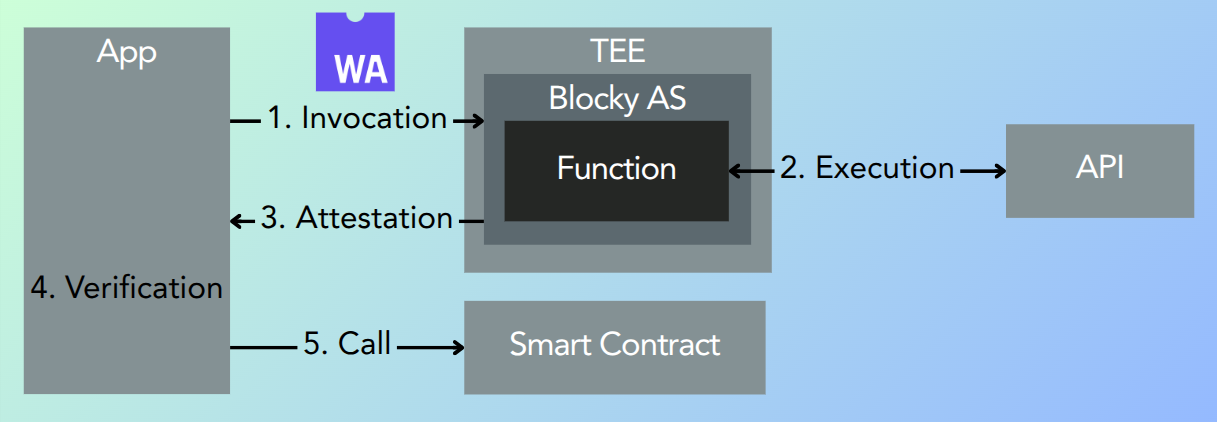
Function Invocation
The user application defines a function that sends a request to an API, parses its response, and returns an output after processing the API data. You can compile this function into a WASM binary and invoke it on a Blocky AS server running inside a TEE. As part of the function invocation, you may also pass in parameters and secrets.Function Execution
The Blocky AS server spins up a WASM runtime to execute the function. The function makes HTTPS requests, processes the API responses, and returns output to the Blocky AS server. Blocky AS WASM runtime and SDK also support verifiably random number generation and wall clock time access.Function Attestation
Blocky AS creates TEE-backed attestation over the function's name, WASM binary, input, hash of secrets, and output, and sends the attestation back to the application.
Attestation Verification
The application verifies the attestation to take further actions, such as updating its UI, or archiving the attestation for later use. Blocky AS also supports attestation verification inside its WASM runtime allowing applications to implement reentrant computation of time-weighted average prices (TWAPs) and other multi-stage processes.
Smart Contract Calls
Finally, the application passes the attestation as calldata to a smart contract. The smart contract verifies the attestation and uses the confirmed data to perform onchain actions.
Trusted Execution Environments (TEEs) are hardened systems that provide the code executing within them certain security and correctness guarantees. Specifically, TEEs provide:
- Confidentiality: TEEs protect the state of a running program from being observed by other software running on the same system. This means that no one, including Blocky, can inspect the state of the program or its memory.
- Integrity: TEEs ensure that the programs they run are not modified, or replaced during execution. This means that the output of a program running in a TEE is the result of the program code and its input.
TEEs such as AWS Nitro Enclaves and Google Confidential Spaces implement these guarantees by running programs in secure virtual machines (VMs), also known as enclaves. An enclave runs on CPU cores and memory isolated from the rest of the underlying system. A key part of a TEE architecture is how it implements this isolation. You can read more about the security architecture of AWS Nitro Enclaves here and Google Confidential Spaces here. An advantage of using TEEs inside cloud datacenters is the cloud providers' processes for preventing unauthorized physical access to the hardware. Finally, enclaves have access a network interface, which enables their programs to accept user requests, access external data, and emit output.
The way TEEs demonstrate program execution guarantees is through TEE attestations. An enclave program has access to a TEE secure module that can generate TEE attestations. A TEE attestation is a signed data structure that contains a series of byte arrays representing measurements (hashes) of the enclave software stack and the host environment. An enclave in AWS Nitro Enclaves or Google Confidential Spaces is instantiated from a Docker image that contains a program executable and its dependencies. One of the measurements in a TEE attestation is of that image and, together with several other measurements of the host environment, we call it the code_measurement. When, as is the case with Blocky Attestation Service, that image is created via a reproducible build process, the code_measurement attests to the program code running in the enclave. A TEE attestation also defines fields for user-defined byte arrays, which can be used to emit attested data from a program running inside an enclave. You can learn more about AWS Nitro Enclave attestation structure here and about Google Confidential Spaces attestation structure here.
Data in an attestation is signed by the TEE secure module using the TEE hardware manufacturer's private key tee_priv_key. The tee_priv_key is the root of trust for a TEE attestation. TEE operators publish the corresponding public key tee_pub_key to allow users to verify attestation signatures. AWS publishes the Nitro Enclaves public key here. Google publishes their Confidential Spaces public key here.
Given the TEE execution model, how does a user trust the output of a program running in a TEE? First, a user verifies the authenticity of a TEE attestation by checking its signature with the well-known tee_pub_key. Next, the user inspects several fields in the attestation to verify the enclave's software stack. This step can vary depending on the TEE architecture, but the good news is that the Blocky Attestation Service CLI does this automatically for our customers using source-available code. Finally, the user compares the attestation's code_measurement against measurements of the image resulting from a reproducible build process that embeds in the image a program executable and its dependencies. When these measurements match, the user can trust that the output in the attestation was produced by code that compiled to the program executable in the image and executed in a TEE enclave.
Two challenges of using TEE attestations directly to attest program output are that the TEE attestations can be relatively time-consuming to obtain from the TEE secure module and complex to verify, especially in a smart contract. Blocky Attestation Service solves these challenges by producing two types of attestations: Enclave Attestations and Transitive Attestations.
The Blocky Attestation Service runs a server application inside a TEE enclave. On startup, the application generates a new public/private key pair encl_app_pub_key/encl_app_priv_key. Since the server runs inside a TEE, the encl_app_pub_key can be trusted to be generated by the server application's code, not tampered with, and not disclosed to anyone, including Blocky.
In the context of the Blocky Attestation Service, an Enclave Attestation attests the encl_app_pub_key and the code_measurement of the Blocky AS server application image. When interacting with a Blocky AS server, for example through the bky-as attest-fn-call CLI command, the CLI produces JSON output that contains an enclave_attested_application_public_key
"enclave_attested_application_public_key": {
  "enclave_attestation": "eyJQbGF0Zm9ybSI6Im...",
  "claims": {
    "enclave_measurement": {
      "platform": "nitro",
      "code": "a16b6d19caa4b3a1f..."
    },
    "public_key": {
      "curve_type": "p256k1",
      "data": "BPePAT3ACi2DNnOfi..."
    }
  }
}
Depending on the size of the encl_app_pub_key, a single TEE attestation may not provide enough space in its program output fields to include all the key's bytes. We solve this problem, by serializing the encl_app_pub_key across several TEE attestations. The enclave_attestation field contains a serialized array of TEE attestations, each containing a portion of the encl_app_pub_key. Each of these TEE attestations also contains the code_measurement of the Blocky AS and is signed by the TEE hardware manufacturer's private key tee_priv_key.
The bky-as CLI deserializes the enclave_attestation and checks the signatures of the TEE attestations against the tee_pub_key, and extracts a set of claims. claims.enclave_measurement contains the platform field, which identifies the TEE platform - in this case the keyword nitro indicates that TEE attestations in the enclave_attestation were produced by an AWS Nitro Enclave. claims.enclave_measurement contains the code field, which reports the code_measurement of the Blocky AS server application image. Finally, claims.public_key contains the encl_app_pub_key, where public_key.curve_type reports the key's cryptographic curve and public_key.data the key's serialized bytes.
Since the bky-as code is source-available to our customers, users can inspect its enclave_attestation verification process to trust that the encl_app_pub_key was generated by the Blocky AS server application code running in a TEE enclave, which guarantees the confidentiality and integrity of the encl_app_priv_key.
In the context of the Blocky Attestation Service, a Transitive Attestation is a data structure produced by a program running inside an enclave that contains the program's output signed by the Blocky AS server application private key encl_app_priv_key. When interacting with the Blocky AS server through the bky-as attest-fn-call CLI command, the CLI produces JSON output that contains a transitive_attested_function_call
"transitive_attested_function_call": {
  "transitive_attestation": "WyJXeUpQVkdob1RYc...",
  "claims": {
    "hash_of_code": "98a384a2ca617e966d...",
    "function": "helloWorld",
    "hash_of_input": "a69f73cca23a9ac5c8...",
    "output": "SGVsbG8sIFdvcmxkIQ==",
    "hash_of_secrets": "9375447cd5307bf747..."
  }
}
The transitive_attestation field contains a serialized data structure that represents a set of claims signed by the encl_app_priv_key. When invoking a Blocky AS server with the bky-as attest-fn-call CLI command, the claims represent the execution of a WASM guest function invoked by the Blocky AS server program. The bky-as CLI deserializes the transitive_attestation, checks the signature against the encl_app_pub_key from the Enclave Attestation, and extracts the claims from the Transitive Attestation. You can also verify a Transitive Attestation yourself by checking its signature with the encl_app_pub_key from the Enclave Attestation.
The advantages of using Transitive Attestations is that they are faster to obtain and are smaller and faster to verify than Enclave Attestations. The Blocky Attestation Service can produce Transitive Attestations in a variety of formats, including signed JSON Web Tokens (JWTs), or ABI-encoded data for verification inside smart contracts. If your use case needs Transitive Attestations in a different format, please reach out to us.
Ultimately, users can trust the output of a program executed on a Blocky AS server, because the signature of the claims in a Transitive Attestation maps to the tee_priv_key or the TEE root of trust. The diagram below shows this mapping. We color code the different parts of mapping to make it easier to follow.
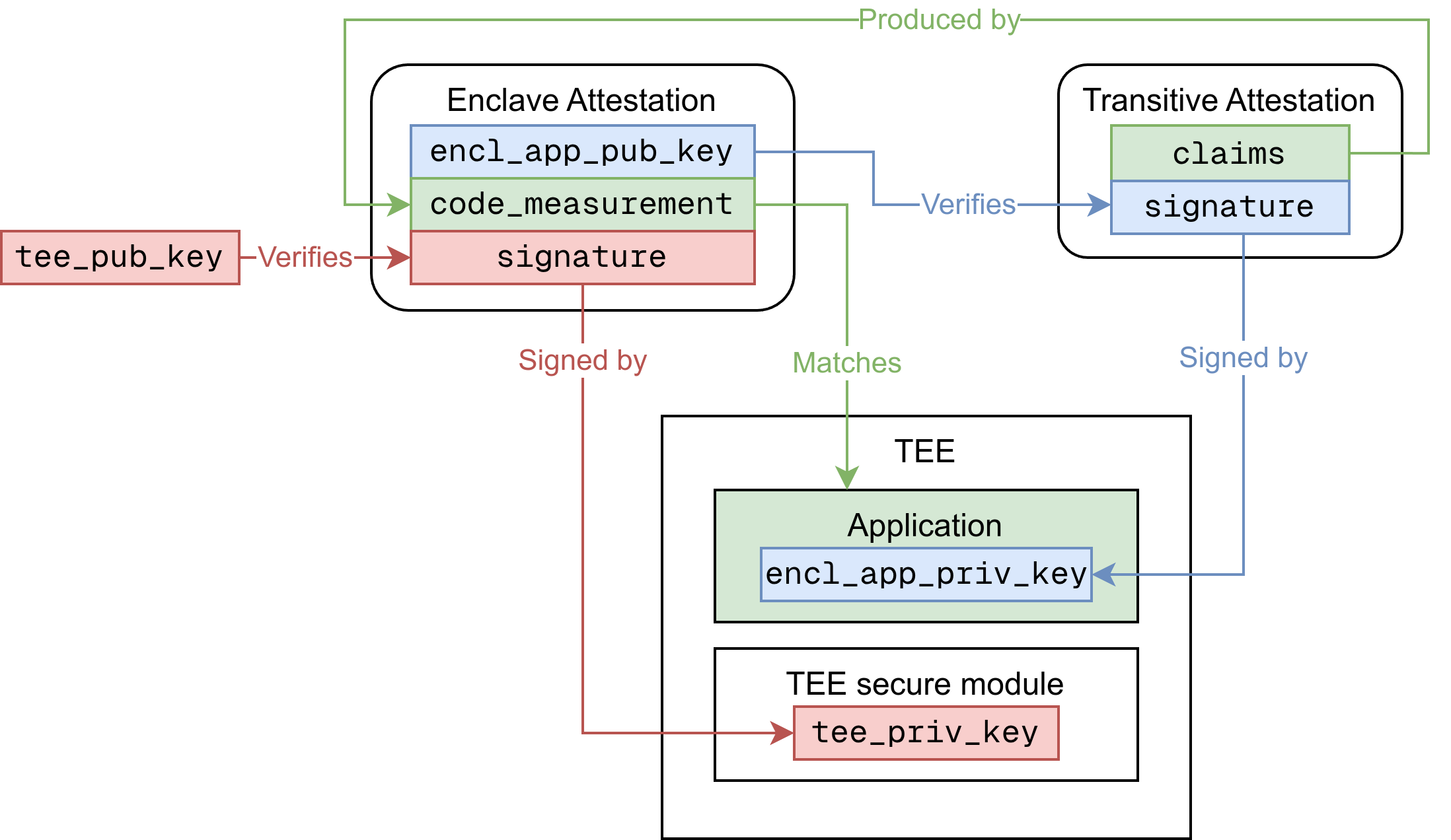
- The red path shows that the
tee_pub_keyverifies the Enclave Attestationsignaturesigned by thetee_priv_key. - The blue path shows that the
encl_app_pub_key, attested in the Enclave Attestation, verifies the Transitive Attestationsignaturesigned by theencl_app_priv_key. - Finally, the green path shows that the
claimsin the Transitive Attestation are produced by an image represented by thecode_measurement, which is attested in the Enclave Attestation and represents the program code running in the TEE.